
 01/04/2026
Picture this: It’s Monday morning. Your network operations center has six dashboards open across three monitors. Alerts are firing from your fault management system and your APM tool simultaneously. One team is investigating a device timeout; another is chasing an application latency spike. Everyone is busy. Everyone is working. And yet, no one has the full picture.
This is the paradox of fragmented monitoring. What looks like control, multiple specialized tools, dedicated teams, layered visibility is often chaos in disguise. The more tools you add to your stack, the wider the gaps between them grow. And in network operations, gaps don’t stay quiet for long.
Fragmented monitoring usually isn’t a conscious decision. It’s what you end up with. A tool for networks here, another one for applications, and over time, they just stack up. Each one does its job, more or less. But they don’t really connect.
So when something goes wrong, you’re not looking at one clear picture. You’re looking at fragments. One dashboard says everything’s fine. Another shows a spike. A third throws an alert that may or may not be related. And suddenly, the problem isn’t just the issue, it’s figuring out where to even look.
That’s fragmented monitoring. Not a lack of visibility, but a lack of alignment.
The Cost of Operating Without a Unified View
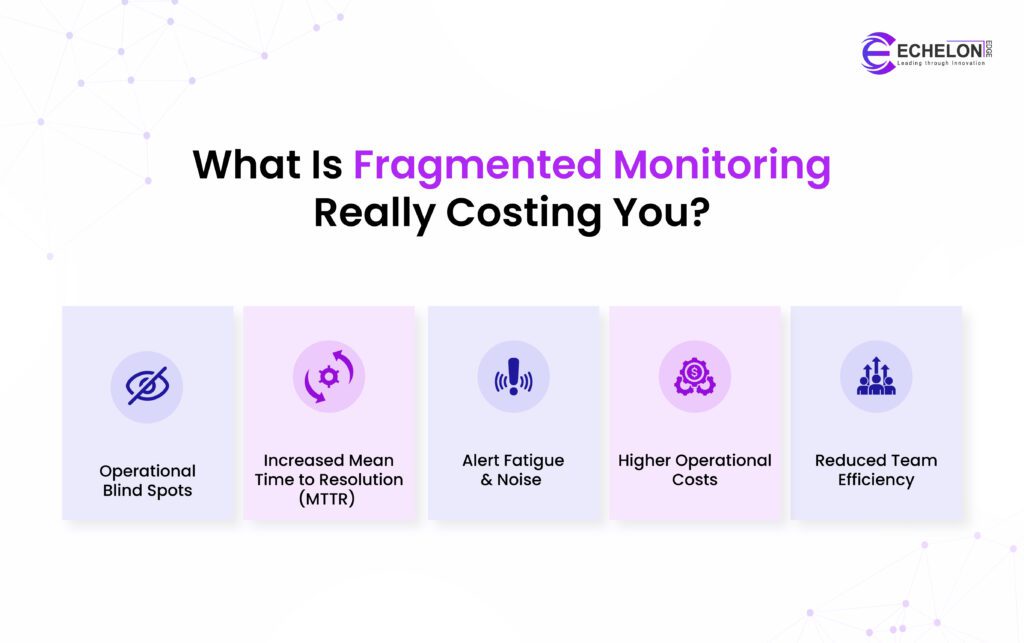
On paper, every layer of the system is being monitored. In practice, visibility remains incomplete.
Each tool provides a partial view, but never a unified perspective. When issues emerge, the signals exist but in isolation. A spike in application latency, a network fluctuation, and an anomalous system log may all be related. However, without correlation across tools, these connections are often missed. The challenge is not the absence of data, but the absence of context.
The initial minutes of an incident are critical and this is where fragmented environments introduce delays.
Teams are forced to navigate multiple tools to piece together the state of the system. Network, application, and infrastructure teams operate within separate views, slowing alignment. As a result, root cause analysis becomes coordination-heavy rather than insight-driven, extending resolution times and increasing the risk of escalation.
Fragmented systems generate a high volume of alerts, often without meaningful differentiation.
A single incident can trigger multiple notifications across tools, each presenting limited context. Over time, this leads to desensitization, where alerts are no longer treated as actionable signals. The real risk emerges when critical incidents are indistinguishable from routine noise.
Fragmentation introduces both direct and indirect costs.
Multiple tools require separate licensing, maintenance and integration efforts. In addition, teams must be trained across different platforms, each with its own interface and operational logic. Individually, these costs may appear manageable but collectively, they create significant operational overhead.
Tool fragmentation often leads to operational silos.
Network, application, and infrastructure teams rely on separate systems and datasets, resulting in misaligned perspectives. Collaboration slows as teams first work to establish a shared understanding before addressing the issue itself. This added friction reduces overall efficiency and delays resolution.
Addressing fragmented monitoring isn’t about adding another tool, it’s about bringing existing layers together into a more coherent system of visibility and control.
Platforms like Percipient NMS are designed to eliminate this fragmentation by unifying network visibility, correlating events across layers, and enabling faster, insight-driven operations. This creates a clearer, end-to-end view of what’s happening across the network.
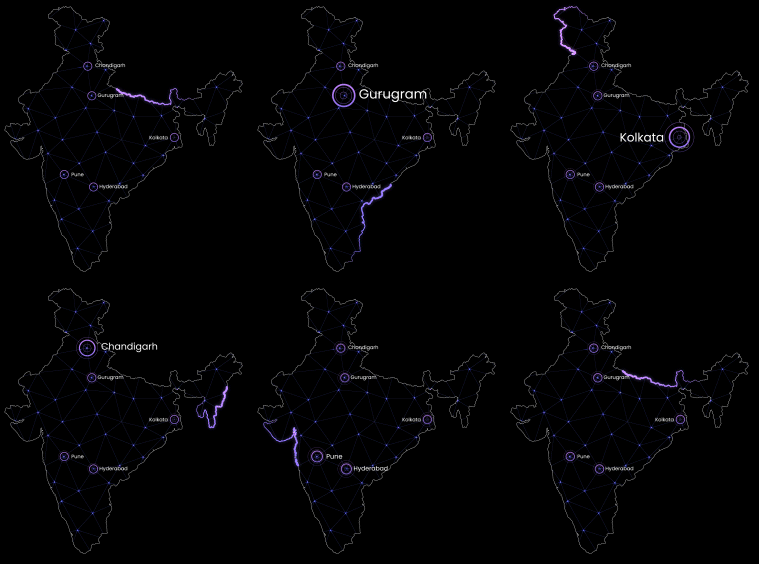
Modern networks are not only large, they’re distributed and diverse. The approach is built to scale across extensive device ecosystems while maintaining consistent visibility. Whether monitoring a few hundred devices or a large, multi-location infrastructure, the system adapts without introducing additional complexity.
A key shift is moving from reactive monitoring to proactive operations.
Automation reduces repetitive manual effort and accelerates response times, while unified visibility ensures that all teams are working from the same, real-time context. This eliminates the need to constantly switch between tools or reconcile conflicting data points.
Ultimately, the idea is simple which is less fragmentation and more clarity.
By consolidating monitoring and aligning it with operational intelligence, the focus shifts from managing tools to managing outcomes.

Fragmented monitoring doesn’t fail because of a lack of tools, it fails because those tools don’t work together. As networks grow more complex, the ability to connect signals, context, and action becomes far more valuable than simply adding another layer of visibility.
Moving toward a unified approach isn’t just an operational improvement, it’s a strategic shift toward clarity, speed, and resilience.
If you’re exploring ways to simplify your monitoring stack and gain a more connected view of your network, solutions like Percipient NMS can be a starting point. Connect with our experts to see how a more integrated approach can work for your environment.

Technical Content Writer
Driven by a passion for storytelling and technology, I translate complex concepts into clear, impactful narratives. My work revolves around exploring emerging trends, digital transformation, and innovation across industries. With a strong curiosity for tech-driven knowledge and a love for reading, I’m always seeking new ideas that inspire smarter communication and deeper understanding.
marketing@echelonedge.com


Copyright ©2023 Echelon Edge Pvt Ltd | All Right Reserved | Cookies Policies
