
 19/05/2026
For years, enterprises in India treated compute like a utility, something you rent, scale and rarely question. But AI has changed the rules.
Today, over 65% of organizations are already exploring or deploying AI according to IBM. And these workloads can demand up to 10-100x more compute than traditional applications as per reports by NVIDIA.
Training models, running real-time inference, and powering generative applications require a different class of infrastructure, one built on GPUs, not just CPUs. And suddenly, where that infrastructure lives starts to matter.
India is now witnessing a quiet but decisive shift: the rise of homegrown GPU clouds. What was once dominated by global hyperscalers is evolving into a more localized, performance-driven ecosystem shaped by data sovereignty, latency needs, and cost realities. For enterprises, this isn’t just another cloud trend, it’s a strategic inflection point that could redefine how they build, deploy, and control AI at scale.
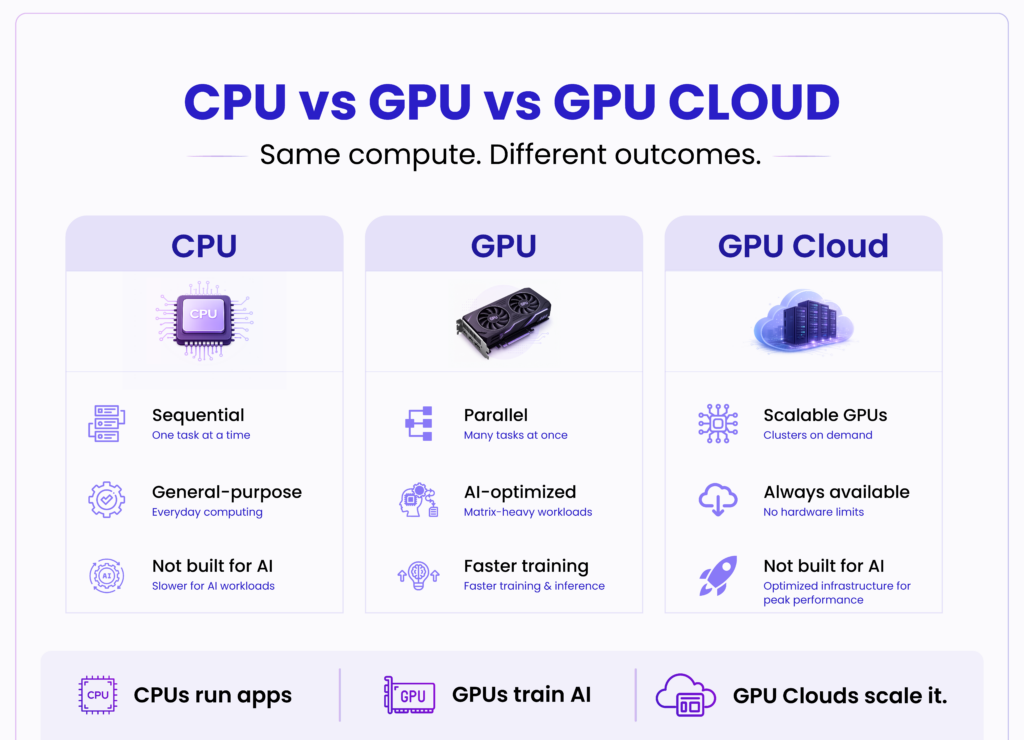
At a basic level, the difference between CPUs and GPUs comes down to how they process work. CPUs are designed for versatility, they handle a wide range of tasks, one at a time, with high precision. That’s why they power everything from business applications to databases. GPUs, on the other hand, are built for parallelism. They can process thousands of smaller tasks simultaneously, making them exceptionally good at handling the kind of matrix-heavy computations that modern AI models rely on.
This architectural difference is exactly why GPUs have become the backbone of AI. Training a deep learning model involves processing massive datasets and performing billions of calculations across neural networks. On a CPU, this would take days or even weeks. GPUs compress that timeline dramatically, enabling faster training, real-time inference, and the ability to iterate quickly. Whether it’s powering recommendation engines, fraud detection systems, or generative AI applications, GPUs make these workloads not just possible, but practical at scale.
This is where GPU clouds come in. Unlike general-purpose cloud infrastructure which is optimized for a mix of workloads, GPU clouds are purpose-built for compute-intensive tasks. They offer high-performance GPU clusters, optimized networking, and software stacks tailored for AI and machine learning. In a general cloud setup, GPUs are often just an add-on, limited, expensive and not always optimized for sustained AI workloads. GPU-specialized clouds, however, are designed from the ground up to deliver consistent performance, better resource utilization, and faster turnaround for AI-driven tasks.
For enterprises, the distinction matters more than ever. As AI moves from experimentation to production, infrastructure is no longer just a backend decision, it directly impacts speed, cost and the ability to compete. GPU clouds aren’t just about more power; they’re about unlocking a different level of efficiency and capability in how AI systems are built and deployed.
The growth of GPU clouds in India isn’t happening in isolation, it’s being fueled by a combination of technological demand, regulatory shifts and economic realities. Together, these forces are pushing enterprises to rethink where and how they access high-performance compute.
AI is no longer limited to tech companies or experimental teams. In India, sectors such as BFSI are using AI for fraud detection and risk modeling, healthcare is leveraging it for diagnostics and drug discovery and startups are building entire products around generative AI.
As these use cases move from pilot to production, the demand for scalable, high-performance compute has surged. Enterprises need infrastructure that can handle continuous training, fine-tuning, and real-time inference. This shift naturally favors GPU-backed environments over traditional cloud setups.
With increasing scrutiny around data privacy and governance, enterprises are becoming more cautious about where their data and the compute processing it, resides. Regulations and internal policies are pushing organizations to keep sensitive data within national borders.
GPU clouds based in India offer a compelling advantage here. They allow enterprises to meet compliance requirements while still accessing cutting-edge AI infrastructure. More importantly, they reduce dependency on global providers, giving organizations greater control over critical workloads.
India’s broader digital transformation agenda is also playing a key role. Government initiatives aimed at strengthening data center ecosystems, improving connectivity, and supporting AI innovation are creating a favorable environment for GPU cloud providers.
There’s a clear intent to position India not just as a consumer of AI technologies, but as a builder of core infrastructure. This push is encouraging investments in local GPU clusters, AI research, and cloud capabilities, accelerating the overall ecosystem.
Running AI workloads on overseas infrastructure often comes with hidden costs, higher latency, data transfer fees, and performance inconsistencies. For applications that require real-time responses such as conversational AI or fraud detection systems, even small delays can impact user experience and outcomes.
Local GPU clouds address this by bringing compute closer to where data is generated and consumed. This reduces latency significantly and can lead to more predictable performance. At the same time, pricing models tailored to the Indian market often make these solutions more cost-effective for sustained, large-scale workloads.
India’s GPU cloud space isn’t as straightforward as it used to be. It’s no longer just a few big players calling the shots. Now, you’ve got global cloud giants, Indian providers, and AI-focused startups all in the mix, building, competing and sometimes even teaming up. It’s a more crowded space, but also a much more interesting one.
Global cloud providers like AWS, Google Cloud, and Azure still play a major role, especially for enterprises that are already deeply tied into their ecosystems.
In fact, AWS continues to lead with roughly 29% of the cloud GPU market in 2025, followed by Microsoft Azure at around 20% (largely driven by its OpenAI partnership), and Google Cloud at about 13%, with a strong focus on integrated AI stacks.
But despite that dominance, their GPU offerings can feel limited, expensive, or simply hard to access when demand spikes. That gap is what’s creating room for something new.
Indian players are stepping into that space with more focused offerings. Companies such as E2E Networks and Cyfuture AI are building GPU-first platforms designed specifically for AI workloads, offering on-demand access to high-end GPUs like H100 and A100 within India.
Beyond established providers, a new wave of niche GPU cloud platforms and AI infra startups is emerging. These companies are highly specialized, they focus exclusively on AI training, inference, and high-performance computing rather than broad cloud services.
Platforms like inhosted.ai and NxtGen’s SpeedCloud AI are examples of this shift. They offer GPU-as-a-Service models with optimized stacks (TensorFlow, PyTorch, CUDA), high-speed interconnects, and infrastructure designed specifically for large-scale AI workloads.
This specialization matters. Instead of treating GPUs as an add-on, these platforms are built “GPU-first,” enabling better performance, faster setup, and more efficient utilization, especially for enterprises running continuous AI pipelines.
As GPU clouds take root in India, the value for enterprises goes well beyond just “more compute.” It directly impacts performance, compliance, cost efficiency, and how quickly teams can move from idea to production.
When AI workloads run closer to where users and data are located, response times improve significantly. This is especially critical for real-time applications, think chatbots, fraud detection systems, recommendation engines, or video analytics, where even slight delays can degrade user experience or decision accuracy.
Local GPU clouds reduce the physical and network distance between compute and end users, resulting in faster inference and more consistent performance. For enterprises, this translates into smoother customer interactions and more reliable AI-driven outcomes.
As data privacy and governance become stricter, enterprises are under increasing pressure to ensure that sensitive data remains within national boundaries. This is particularly relevant for sectors such as BFSI, healthcare and government.
India-based GPU clouds make it easier to meet these requirements by keeping both data and compute local. Instead of navigating complex cross-border data flows, organizations can simplify compliance while maintaining full control over how their data is processed and stored.
Running GPU workloads on global hyperscalers can become expensive, especially at scale. Costs often include not just compute, but also data transfer fees, currency fluctuations, and premium pricing for scarce GPU resources.
Local GPU cloud providers are increasingly offering more predictable and competitive pricing models tailored to the Indian market. With INR billing, lower data egress costs, and infrastructure optimized for AI workloads, enterprises can achieve better cost efficiency, particularly for long-running training jobs and continuous inference workloads.
AI development is inherently iterative. Teams need to train models, test variations, fine-tune parameters, and deploy quickly. Any delay in provisioning infrastructure or accessing GPUs can slow down innovation.
GPU-specialized clouds in India are designed for rapid provisioning and high availability of resources. This allows teams to spin up environments quickly, run experiments in parallel, and move from prototype to production faster. The result is shorter development cycles and a stronger ability to respond to market demands.
While the momentum behind GPU clouds in India is strong, it’s not without friction. Enterprises stepping into this space need to be clear-eyed about the constraints that can impact scale, cost and long-term flexibility.
High-performance GPUs are in global demand, and supply hasn’t always kept pace. This creates bottlenecks, limited availability, longer wait times and sometimes restricted access to the latest hardware.
For enterprises, this can delay critical AI initiatives or force compromises on infrastructure choices. Even with local providers, access to cutting-edge GPUs can fluctuate depending on global supply chains.
Building and maintaining GPU infrastructure is capital-intensive. From hardware procurement to cooling, power and networking, the costs add up quickly.
While GPU clouds abstract some of this complexity, the pricing still reflects the underlying expense. For enterprises running large-scale or continuous workloads, managing and optimizing these costs becomes a key challenge, especially without clear visibility into usage efficiency.
GPU infrastructure isn’t plug-and-play. Running AI workloads efficiently requires expertise in distributed computing, model optimization, workload orchestration and frameworks like PyTorch or TensorFlow.
Many enterprises still face a talent gap here. Without the right skills, even the most advanced infrastructure can be underutilized, leading to wasted spend and suboptimal performance.
As GPU cloud providers differentiate through proprietary tools, optimized stacks, and managed services, switching between platforms can become difficult.
Enterprises that deeply integrate with a single provider may find it challenging to migrate workloads later, whether due to cost changes, performance issues, or evolving requirements. This makes architectural flexibility and multi-cloud strategies increasingly important from the outset.
Beyond performance and cost, GPU clouds are becoming central to a much larger conversation, control. As AI becomes a core capability, the question isn’t just how enterprises run models, but where and under whose control that compute resides.
Digital sovereignty is about ensuring that a country, or an organization has control over its data, infrastructure, and critical technologies. GPU clouds sit right at the heart of this.
If AI models are trained and deployed on infrastructure outside national boundaries, control over data flows, security, and access becomes more complex. Local GPU clouds help anchor this control within the country’s regulatory and operational framework.
Most enterprises today “rent” compute from global providers. While convenient, this creates a dependency, on pricing, availability and even geopolitical factors.
The rise of domestic GPU clouds introduces an alternative: more control over compute resources, predictable access, and reduced reliance on external ecosystems. It’s not necessarily about full ownership, but about having strategic options and avoiding single points of dependency.
For enterprises, this shift impacts long-term resilience. Control over AI infrastructure can influence everything from product innovation to risk management. Those who diversify their compute strategy are better positioned to adapt to market or regulatory changes.
For governments, GPU clouds are becoming as critical as physical infrastructure. They enable national AI capabilities, support innovation ecosystems and reduce reliance on foreign technology stacks.
ALSO READ: What is Sovereign AI and Why It Will Reshape India’s Infrastructure Stack?
AI is forcing enterprises to care about something they’ve ignored for years, where their compute actually lives. Because once you scale, it stops being invisible. It shows up in slower responses, rising bills, and limited access to GPUs when you need them most.
That’s why India’s GPU cloud story matters. Not because it replaces everything, but because it gives you an option that’s closer, faster, and sometimes just more practical. The advantage right now is simple as the earlier you figure out where local GPU infrastructure fits, the less you struggle later.

Technical Content Writer
Driven by a passion for storytelling and technology, I translate complex concepts into clear, impactful narratives. My work revolves around exploring emerging trends, digital transformation, and innovation across industries. With a strong curiosity for tech-driven knowledge and a love for reading, I’m always seeking new ideas that inspire smarter communication and deeper understanding.
info@echelonedge.com
marketing@echelonedge.com


Copyright ©2023 Echelon Edge Pvt Ltd | All Right Reserved | Cookies Policies