top

All You Need to Know About Context-Driven AI in Network Management Systems (NMS)

27/05/2026
Context-Driven AI in Network Management Systems

Network operations teams today are drowning in data but starving for insight. Modern enterprise networks generate thousands of alerts every day, interface flaps, latency spikes, BGP route changes, device reboots yet most Network Management Systems (NMS) still treat each event in isolation, stripped of the context that makes it meaningful. Traditional NMS platforms can tell operators what happened, but rarely why it matters.

But what if the next generation of NMS platforms could do more than monitor? What if they could understand relationships between events, recognize operational patterns, anticipate failures and surface the incidents that truly impact services and users?

As networks continue to expand across cloud, SD-WAN, edge and distributed infrastructure environments, the future of network operations may depend less on seeing more data and more on understanding the context behind it. Context-Driven AI is emerging as a promising direction for modern NMS platforms, one that could gradually shift network operations from reactive monitoring toward more intelligent, predictive and context-aware operations.

In this blog, let’s explore how Context-Driven AI could shape the future of network management and redefine the way operations teams monitor, troubleshoot and optimize complex enterprise networks.

The Growing Gaps in Traditional Network Management

Despite advances in monitoring technologies, most traditional NMS platforms still struggle to deliver meaningful operational insight in increasingly complex network environments. Some of the most common challenges include:

  • Rule-Based Alerting Leads to Alert Fatigue: Traditional NMS platforms rely heavily on static thresholds and predefined rules, generating thousands of alerts every day. Many of these alerts are repetitive, low priority or temporary, forcing operations teams to spend more time filtering noise than resolving critical incidents. This overload increases operational fatigue and the risk of missing important issues.
  • Siloed Data Creates Visibility Gaps: Network topology, traffic analytics, device logs and user experience data often exist across separate tools and dashboards. Because traditional NMS platforms rarely unify this information, operators struggle to correlate events, identify root causes and understand the broader impact of network issues.
  • Reactive by Design: Conventional NMS solutions typically respond only after thresholds are breached or services begin to fail. This reactive approach limits the ability of teams to anticipate problems, detect early warning signs or prevent outages before users are affected.
  • No Awareness of Business Impact: Most traditional systems treat alerts with equal priority, without considering operational or business context. A network issue during a critical business window may have significant consequences, while the same issue during off-hours may be far less important. Yet conventional NMS platforms often fail to distinguish between the two.

What “Context” Actually Means in NMS?

In modern network management, context refers to the ability of an NMS platform to understand not just what event occurred, but the surrounding conditions, dependencies and operational impact associated with it. Instead of treating alerts as isolated incidents, context-driven systems analyze events through multiple dimensions to determine their actual significance.

  • Temporal Context: Temporal context focuses on when an event occurs. Network behavior often changes depending on the time of day, peak traffic periods, maintenance activities, or business operations. For example, a bandwidth spike during office hours may be expected, while the same activity at midnight could indicate a problem or anomaly. Similarly, device downtime during a low-impact maintenance period may require less attention than an unexpected outage during critical business hours.
  • Topological Context: Topological context examines where an event exists within the network architecture. A failed access switch serving a small branch office has a very different impact compared to a core router connected to multiple critical services. Understanding node dependencies, traffic paths and service relationships helps the NMS identify which incidents are isolated and which may trigger cascading failures across the network.
  • Business Context: Business context helps the NMS understand who and what is affected. Instead of prioritizing alerts purely by technical severity, context-aware systems consider the impact on applications, SLAs, customers or business-critical operations. A minor latency issue affecting a payment gateway or trading application may require higher priority than a larger issue impacting non-critical systems.
  • Historical Context: Historical context uses past incidents, recurring failure patterns, configuration changes and performance trends to improve decision-making. By learning from previous events, the NMS can identify anomalies faster, predict recurring issues and assist teams in resolving problems more efficiently.

How Context-Driven AI Works in NMS?

Context-Driven AI in NMS is built on the idea that network events should not be analysed in isolation. Instead, the system continuously collects, correlates, and interprets operational data from across the infrastructure to understand the significance behind every alert, anomaly, or performance issue. This typically happens through four interconnected layers.
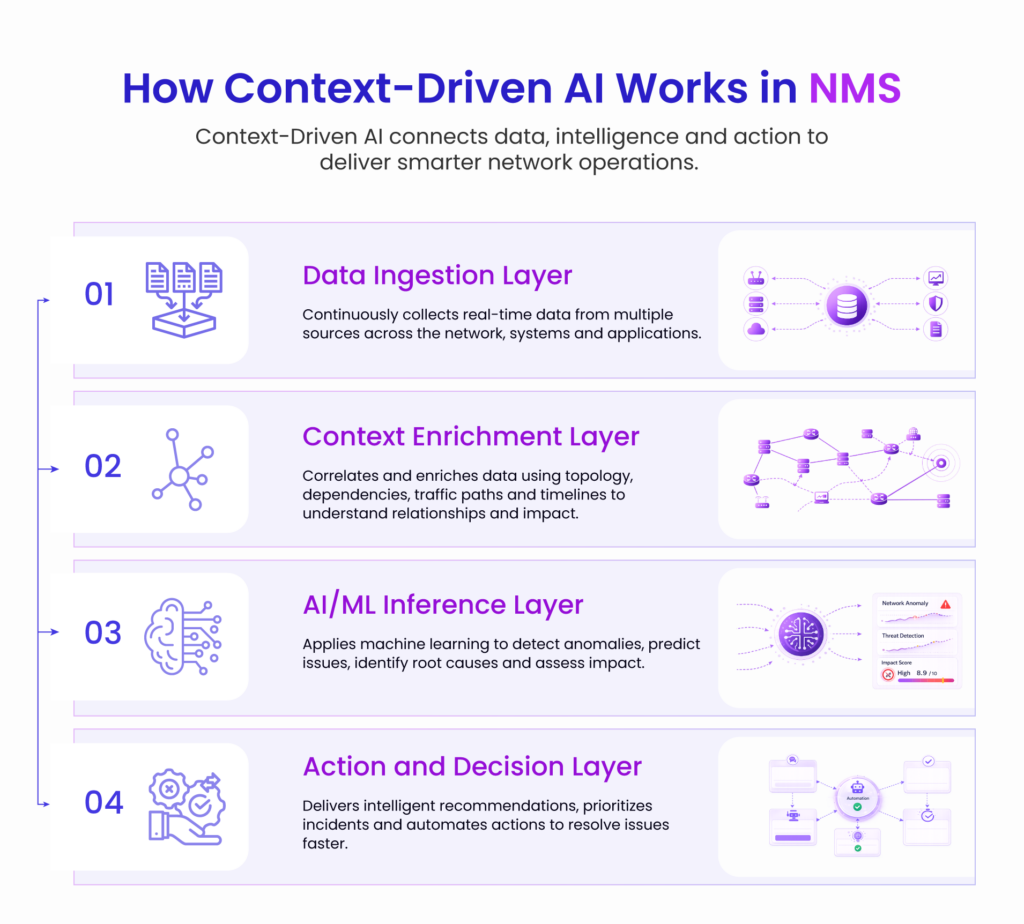
How context driven AI works
  • Data Ingestion Layer: The foundation of a context-aware NMS begins with large-scale data ingestion and normalization. The platform continuously gathers operational information from multiple sources such as streaming telemetry, SNMP, traps, syslogs, NetFlow data, cloud APIs, application monitoring tools, and network devices across the infrastructure. Unlike traditional monitoring systems that rely primarily on periodic polling, modern architectures process continuous operational data streams to maintain a dynamic and near real-time view of network behavior.
  • Context Enrichment Layer: Raw network data alone has limited value unless it is connected and interpreted. The context enrichment layer correlates data across topology models, service dependencies, traffic flows, configuration states, and operational timelines to create meaningful relationships between network events and business services. Modern NMS platforms achieve this through technologies such as graph-based correlation engines, topology discovery frameworks, dependency mapping systems, and time-series analytics platforms. These components help the system understand how devices, applications, cloud resources, and services interact, enabling more accurate root-cause analysis and operational visibility.
  • AI/ML Inference Layer: Once enriched with context, AI and machine learning models analyze the data to identify meaningful operational insights. This layer performs functions such as anomaly detection, predictive analysis, root cause identification and impact scoring. Rather than reacting only to predefined thresholds, the system learns normal behavioral patterns and detects deviations that may indicate early-stage failures, congestion or service degradation.
  • Action and Decision Layer: The final layer focuses on operational response. Instead of overwhelming operators with raw alerts, the NMS delivers intelligent recommendations, prioritized incidents and automated workflows. Depending on policy and confidence levels, the platform may suppress duplicate alerts, trigger auto-remediation scripts, reroute traffic or provide NOC teams with probable root causes and suggested corrective actions.

Key Considerations for Real-World Deployment of Context-Driven AI

While the potential of Context-Driven AI in network management is significant, successful implementation depends on strong operational foundations. AI models are only as reliable as the data they consume, and many enterprises still face challenges with incomplete inventories, outdated topology information, and inconsistent operational data. Poor data quality can lead to inaccurate correlations, misleading root-cause analysis, and unreliable automation outcomes.

Trust and explainability are equally critical. NOC teams need visibility into why the AI prioritized an alert, identified a root cause, or recommended a remediation step. Without transparency, organizations are unlikely to rely on AI-driven decisions in critical environments.

At the same time, fully autonomous network operations remain a long-term goal rather than an immediate reality. Most enterprises are expected to adopt AI gradually, starting with topology-aware correlation, predictive monitoring, and AI-assisted remediation before moving toward closed-loop automation and higher operational autonomy. This phased approach allows organizations to balance innovation with operational control while building trust in AI-driven network management.
The Road Ahead: From Context to Intent

As enterprise networks evolve, the next stage beyond context-aware operations may be intent-driven intelligence. While Context-Driven AI focuses on understanding relationships, dependencies, and operational impact, future systems may also understand intent, what operators and businesses ultimately want to achieve.

This aligns closely with the vision of intent-based networking (IBN), where administrators define desired outcomes instead of manually configuring devices and policies. AI-powered systems could gradually learn from operator behavior, historical actions, and network patterns to recommend proactive changes and support automated decision-making.

However, fully autonomous and self-healing networks remain a long-term goal. Most organizations are expected to adopt AI-driven autonomy gradually, starting with intelligent monitoring, predictive analytics, and recommendation-based remediation before moving toward controlled closed-loop automation. As trust, governance, and explainability improve, enterprises can expand automation while still maintaining human oversight for critical operations.

In this transition, Context-Driven AI serves as an important foundation for building more adaptive, intelligent, and operationally aware network management systems.


Rashi Chandra 

Technical Content Writer

Driven by a passion for storytelling and technology, I translate complex concepts into clear, impactful narratives. My work revolves around exploring emerging trends, digital transformation, and innovation across industries. With a strong curiosity for tech-driven knowledge and a love for reading, I’m always seeking new ideas that inspire smarter communication and deeper understanding.

Related Posts

Copyright ©2023 Echelon Edge Pvt Ltd | All Right Reserved | Cookies Policies

cmmi-w