
 27/05/2026
Network operations teams today are drowning in data but starving for insight. Modern enterprise networks generate thousands of alerts every day, interface flaps, latency spikes, BGP route changes, device reboots yet most Network Management Systems (NMS) still treat each event in isolation, stripped of the context that makes it meaningful. Traditional NMS platforms can tell operators what happened, but rarely why it matters.
But what if the next generation of NMS platforms could do more than monitor? What if they could understand relationships between events, recognize operational patterns, anticipate failures and surface the incidents that truly impact services and users?
As networks continue to expand across cloud, SD-WAN, edge and distributed infrastructure environments, the future of network operations may depend less on seeing more data and more on understanding the context behind it. Context-Driven AI is emerging as a promising direction for modern NMS platforms, one that could gradually shift network operations from reactive monitoring toward more intelligent, predictive and context-aware operations.
In this blog, let’s explore how Context-Driven AI could shape the future of network management and redefine the way operations teams monitor, troubleshoot and optimize complex enterprise networks.
Despite advances in monitoring technologies, most traditional NMS platforms still struggle to deliver meaningful operational insight in increasingly complex network environments. Some of the most common challenges include:
In modern network management, context refers to the ability of an NMS platform to understand not just what event occurred, but the surrounding conditions, dependencies and operational impact associated with it. Instead of treating alerts as isolated incidents, context-driven systems analyze events through multiple dimensions to determine their actual significance.
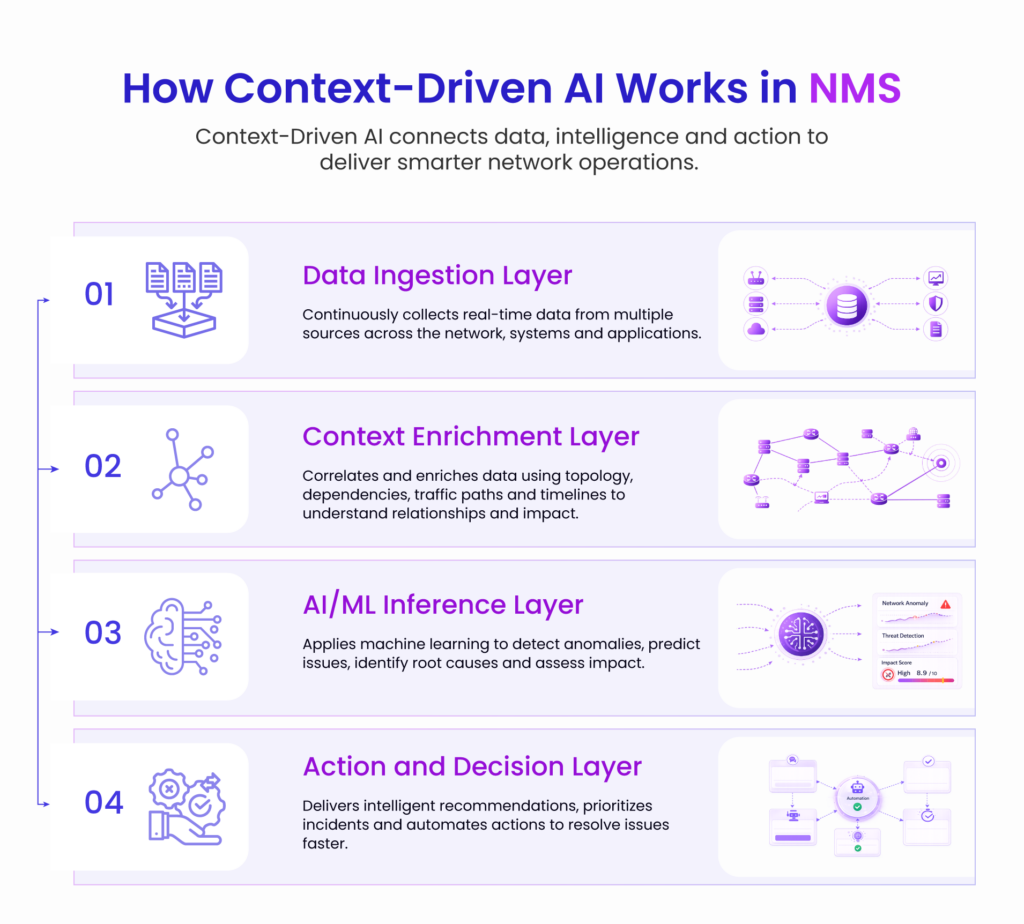
Context-Driven AI in NMS is built on the idea that network events should not be analysed in isolation. Instead, the system continuously collects, correlates, and interprets operational data from across the infrastructure to understand the significance behind every alert, anomaly, or performance issue. This typically happens through four interconnected layers.
While the potential of Context-Driven AI in network management is significant, successful implementation depends on strong operational foundations. AI models are only as reliable as the data they consume, and many enterprises still face challenges with incomplete inventories, outdated topology information, and inconsistent operational data. Poor data quality can lead to inaccurate correlations, misleading root-cause analysis, and unreliable automation outcomes.
Trust and explainability are equally critical. NOC teams need visibility into why the AI prioritized an alert, identified a root cause, or recommended a remediation step. Without transparency, organizations are unlikely to rely on AI-driven decisions in critical environments.
At the same time, fully autonomous network operations remain a long-term goal rather than an immediate reality. Most enterprises are expected to adopt AI gradually, starting with topology-aware correlation, predictive monitoring, and AI-assisted remediation before moving toward closed-loop automation and higher operational autonomy. This phased approach allows organizations to balance innovation with operational control while building trust in AI-driven network management.
As enterprise networks evolve, the next stage beyond context-aware operations may be intent-driven intelligence. While Context-Driven AI focuses on understanding relationships, dependencies, and operational impact, future systems may also understand intent, what operators and businesses ultimately want to achieve.
This aligns closely with the vision of intent-based networking (IBN), where administrators define desired outcomes instead of manually configuring devices and policies. AI-powered systems could gradually learn from operator behavior, historical actions, and network patterns to recommend proactive changes and support automated decision-making.
However, fully autonomous and self-healing networks remain a long-term goal. Most organizations are expected to adopt AI-driven autonomy gradually, starting with intelligent monitoring, predictive analytics, and recommendation-based remediation before moving toward controlled closed-loop automation. As trust, governance, and explainability improve, enterprises can expand automation while still maintaining human oversight for critical operations.
In this transition, Context-Driven AI serves as an important foundation for building more adaptive, intelligent, and operationally aware network management systems.

Technical Content Writer
Driven by a passion for storytelling and technology, I translate complex concepts into clear, impactful narratives. My work revolves around exploring emerging trends, digital transformation, and innovation across industries. With a strong curiosity for tech-driven knowledge and a love for reading, I’m always seeking new ideas that inspire smarter communication and deeper understanding.
info@echelonedge.com
marketing@echelonedge.com


Copyright ©2023 Echelon Edge Pvt Ltd | All Right Reserved | Cookies Policies