28/10/2026

Why invest in a commercial Network Monitoring System (NMS) when your IT team has the expertise to build one in-house? For many enterprises, developing their own monitoring platform seems like a practical choice, offering greater control, customization, and potentially lower upfront costs.
But building a monitoring solution is one thing. Maintaining it as networks expand, devices multiply, and operational requirements become more complex is another. What starts as a cost-saving decision can gradually turn into a long-term engineering commitment.
So, is building an in-house NMS really the smarter investment, or does buying an enterprise-ready platform offer greater long-term value? Let’s explore what enterprises should consider before making that decision.
At first glance, the decision to build or buy a Network Monitoring System (NMS) may seem like a straightforward comparison between development costs and software licensing fees. However, the real differences become apparent when you consider deployment complexity, scalability, operational efficiency, and long-term maintenance.
Building an in-house NMS gives enterprises greater control over how the platform is developed and customized. Buying an enterprise-ready NMS, on the other hand, provides access to established monitoring capabilities, vendor expertise and ongoing product development without having to build everything from scratch.
Here’s how the two approaches compare across key evaluation criteria:
| Evaluation Criteria | Build In-House NMS | Buy Enterprise NMS |
| Initial Investment | Requires investment in engineering resources, development tools, infrastructure, integrations, and testing. | Involves licensing, implementation, configuration, and potential integration costs, depending on the deployment model. |
| Time to Deployment | Development, testing, and integration can extend deployment timelines, particularly for complex networks. | Existing monitoring capabilities and supported integrations can accelerate implementation and time to value. |
| Multi-Vendor Support | Requires developing, testing, and maintaining integrations across different OEMs, protocols, and device types. | Provides pre-existing support for multiple vendors and technologies, subject to platform compatibility. |
| Scalability | Requires continuous architectural planning, performance optimization, and infrastructure upgrades as monitoring requirements grow. | Offers established scalability capabilities, although actual capacity depends on platform architecture and deployment configuration. |
| Fault Management | Event normalization, alert correlation, fault detection, and escalation workflows must be developed and refined internally. | Can provide integrated fault management, event correlation, and alerting capabilities from the outset. |
| Maintenance & Upgrades | Internal teams handle bug fixes, security patches, compatibility updates, and ongoing feature development. | Vendor-supported updates, product enhancements, and technical assistance reduce the internal maintenance burden. |
| Customization & Flexibility | Offers extensive control over features, architecture, integrations, and development priorities. | Supports customization through configurations, APIs, integrations, and available platform capabilities. |
| Technical Expertise | Requires dedicated developers, network engineers, and specialists to build and sustain the platform. | Reduces the need for in-house product development while still requiring skilled teams for configuration and operations. |
| Long-Term Cost (TCO) | Includes development, infrastructure, maintenance, upgrades, engineering resources, and ongoing support costs. | Includes licensing, implementation, support, renewals, and potential expansion costs, with greater predictability depending on commercial terms. |
| Support & Accountability | Troubleshooting, issue resolution, and platform reliability remain the responsibility of internal teams. | Provides access to vendor technical support, defined service commitments, and product roadmaps, depending on the agreement. |
The key consideration: An in-house NMS may offer greater development control, but that control comes with ongoing engineering responsibility. An enterprise NMS can reduce the effort required to develop and maintain core monitoring capabilities, allowing IT teams to focus more on network performance, service availability, and operational priorities.
Ultimately, the decision should be based not just on what it costs to deploy an NMS today, but on what it takes to operate, maintain, and scale it over the next several years.
Building an in-house Network Monitoring System may appear cost-effective initially, especially when an organization already has the technical expertise. However, as network environments grow, several operational and engineering challenges can significantly increase the total cost of ownership.
Enterprise networks rarely operate on devices from a single vendor. Supporting different OEMs, protocols, and device types requires continuous integration development, compatibility testing, and updates. Every new device or technology can add another layer of engineering effort.
Collecting alerts is relatively straightforward. Turning them into actionable insights is more complex. Without effective event normalization and correlation, IT teams may struggle with duplicate alarms, alert noise, and identifying the root cause of network issues.
An NMS designed for a few hundred devices may struggle as the network expands to thousands. Increasing device counts, monitoring metrics, and data volumes demands architectural improvements, performance optimization, and additional infrastructure resources.
Development doesn’t end at deployment. Security patches, bug fixes, feature enhancements, and device compatibility updates require continuous attention. Dependence on a few engineers can also create knowledge gaps when team members leave.
The real cost of an in-house NMS isn’t just building it. It’s the sustained investment required to keep it reliable, scalable, and aligned with evolving network requirements.
The decision largely comes down to three questions: How complex is your network? How much customization do you genuinely need? And how much engineering capacity can you commit to maintaining the platform?
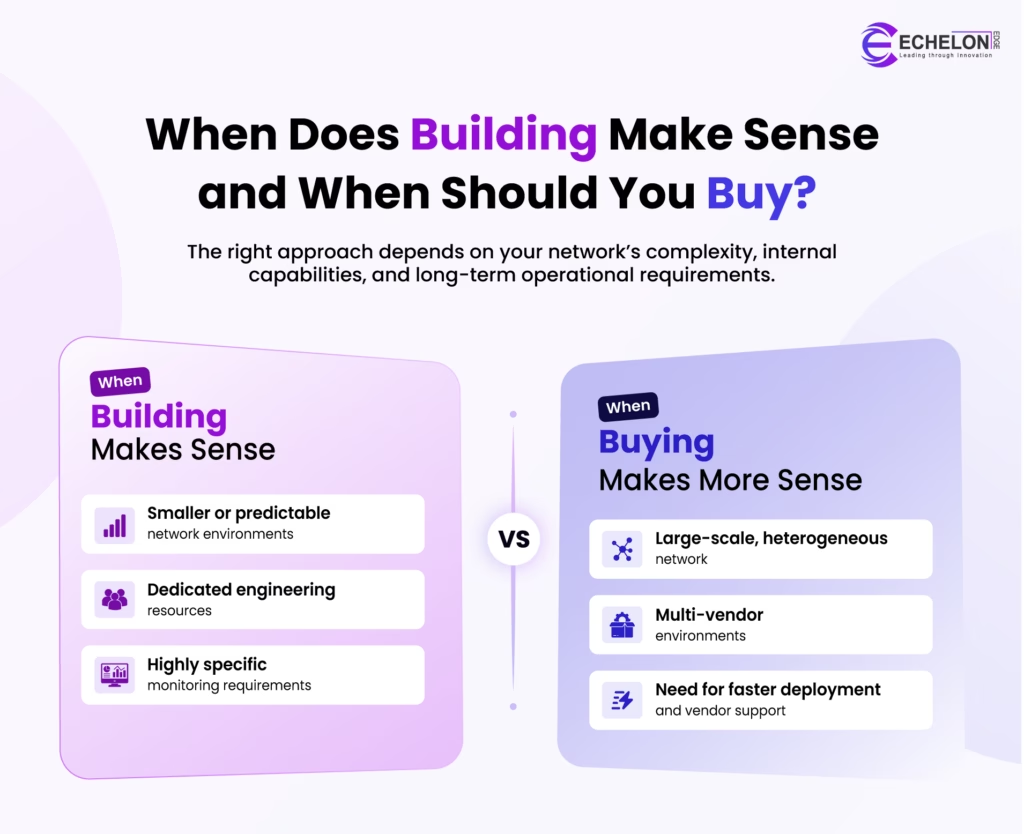
Build when: Your monitoring requirements are highly specialized, your network environment is relatively predictable, and you have a dedicated team capable of supporting the platform throughout its lifecycle.
Buy when: Your priority is to accelerate deployment, manage diverse network technologies, and access established monitoring capabilities without taking on continuous product development responsibilities.
Neither approach is inherently better. The right choice depends on whether building a monitoring platform creates enough strategic value to justify the resources it requires.
For enterprises managing complex network environments, the challenge isn’t simply choosing a monitoring tool. It’s ensuring that the platform can support growing infrastructure, diverse technologies, and evolving operational requirements without continuous development efforts.
This is where Percipient NMS offers an enterprise-ready alternative to building and maintaining a monitoring platform in-house.
Designed for heterogeneous, multi-vendor environments, Percipient NMS brings together unified network visibility, event normalization and correlation, and integrated FCAPS (Fault, Configuration, Accounting, Performance, and Security) capabilities. Its microservices-based architecture supports scalability and flexibility as network requirements evolve.
Its event management capabilities help reduce alert noise, identify related events, and enable faster fault isolation, allowing network teams to focus on issues that require attention.
For enterprises evaluating build versus buy, Percipient NMS provides an established foundation for managing network complexity without having to develop and maintain every monitoring capability from scratch.
Building an in-house NMS offers greater control over development and customization, but it also brings long-term responsibilities around integration, scalability, maintenance, and technical support. Buying an enterprise-ready NMS can reduce these engineering demands while providing established capabilities to manage increasingly complex network environments.
Ultimately, the decision isn’t about whether your team has the expertise to build an NMS. It’s about whether developing and maintaining one is the best use of their time, resources, and expertise.
The right investment is one that supports your network’s needs today while remaining ready for tomorrow’s challenges.

Technical Content Writer
Driven by a passion for storytelling and technology, I translate complex concepts into clear, impactful narratives. My work revolves around exploring emerging trends, digital transformation, and innovation across industries. With a strong curiosity for tech-driven knowledge and a love for reading, I’m always seeking new ideas that inspire smarter communication and deeper understanding.
marketing@echelonedge.com


Copyright ©2023 Echelon Edge Pvt Ltd | All Right Reserved | Cookies Policies