
 12/03/2026
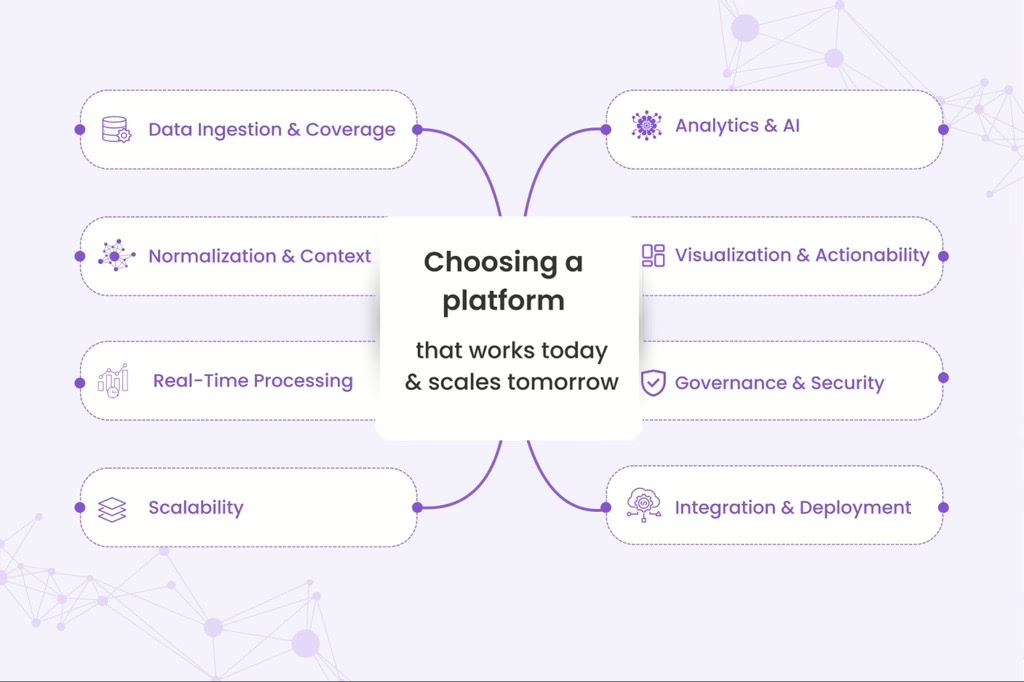
As data platforms become central to operational and analytical decision-making, the challenge for organizations is no longer whether to adopt a unified approach, but how to choose the right one. Platforms may appear similar at a high level, yet differ significantly in how they handle scale, context, intelligence and long-term adaptability.
These differences often surface only after deployment when data volumes grow, use cases expand, and teams expect faster, more reliable insight. Understanding what to evaluate upfront is critical to avoiding costly trade-offs later.
In this blog, we’ll outline the key factors that matter when selecting a unified data platform that can support real-world complexity, not just initial requirements.
Before evaluating platforms, it is essential to clearly define the problem you are trying to solve. Different teams expect different outcomes from a unified data platform, and those expectations should guide the selection process.
Start by identifying the key questions the platform must help answer. Are teams trying to reduce incident resolution time, understand performance trends, improve capacity planning, or support business-level reporting? The answers will shape requirements around data uniqueness, correlation and analytics.
Also consider the types of use cases involved. Some scenarios require real-time visibility and alerting, while others depend on historical analysis or predictive insights. A platform optimized only for batch analysis may struggle with real-time operations just as a real-time system may lack depth for long-term trend analysis.
Equally important is understanding who will use the platform. Operations teams need fast, actionable views, engineers require detailed drill-downs, analysts look for flexible querying and leadership expects high-level insights. A common mistake is selecting a platform based on an impressive feature list rather than its ability to support these outcomes across roles. The right platform aligns capabilities with actual decision-making needs, not just technical checkboxes.
A unified data platform is only as effective as the data it can reliably ingest. Modern environments generate data from a wide range of sources which includes logs, metrics, events and traces across network, application, infrastructure and cloud layers. The platform should be able to ingest this data natively and consistently.
Support for structured, semi-structured and unstructured data is important as operational data rarely conforms to a single format. Platforms that require extensive preprocessing or rigid schemas often slow down onboarding and limit flexibility as new data sources are added.
It is also important to evaluate how data is ingested. Native connectors and built-in integrations reduce deployment effort and ongoing maintenance while heavy customization can increase complexity and long-term cost. Also, ingestion capabilities must scale with data volume and velocity. As environments grow, the platform should handle spikes in data without loss, delay or degradation in performance.
Raw data on its own has limited value. Logs, metrics, events and traces are often generated in different formats with inconsistent naming, timestamps and structures. A unified data platform must be able to normalize this raw input into a common, queryable format so teams can analyze information without spending time translating or reconciling data sources.
Beyond normalization, context is what makes data meaningful. Correlating information across domains such as network performance, application behavior and user impact allows teams to understand not just what happened but why it happened and who was affected. This correlation becomes especially important during incident investigation, where isolated signals rarely tell the full story.
Effective platforms also enrich data with relevant metadata, topology and environmental context. This may include relationships between services, dependencies across infrastructure, or business context tied to specific systems. Normalization and contextualization together form the foundation for accurate analysis, reliable alerts and actionable insights. Without them, even large volumes of data can result in fragmented or misleading conclusions.
The value of a unified data platform often depends on how quickly it can process and analyze incoming information. Real-time processing enables teams to detect issues as they occur while batch-only systems introduce delays that can limit operational effectiveness. Understanding whether a platform supports true stream processing or relies primarily on periodic batch analysis is critical for time-sensitive use cases.
Scalability is equally important. As data volumes grow and environments become more complex, the platform must maintain consistent performance during peak loads and high-ingestion periods. This includes handling sudden spikes in data without data loss, lag, or system instability.
A future-proof platform is designed for horizontal scalability, allowing capacity to expand seamlessly as requirements evolve. Poorly designed architectures can create ingestion, processing, or query bottlenecks as new data sources are added. Evaluating how a platform scales under real-world conditions helps ensure it remains effective over the long term.
Analytics and intelligence capabilities determine how effectively a platform turns data into insight. Some platforms rely heavily on external or bolt-on tools for analysis, which can introduce complexity and limit correlation across data types. Built-in analytics enable faster insight by operating directly on normalized, contextualized data.
Advanced platforms support capabilities such as anomaly detection, forecasting, and root cause analysis to help teams move from reactive monitoring to proactive decision-making. These capabilities reduce manual effort and improve consistency, particularly in large or dynamic environments.
It is also important to evaluate how intelligence is implemented. Single-model approaches may be effective for narrow use cases, while multi-model or multi-agent intelligence can handle diverse data patterns and evolving conditions more effectively. Finally, explainability matters. Teams must be able to understand why an insight or recommendation was generated in order to trust and act on it. Transparent and interpretable intelligence builds confidence and drives adoption across the organization.
Importantly, in enterprise environments AI should primarily function as decision-support rather than automated decision-making. As organizations place increasing emphasis on accountability and governance, platforms that provide clear reasoning and human-guided intelligence help technology leaders adopt AI with greater confidence.
ALSO READ: How Does Machine Learning Transform Network Visibility in NMS?
Visualization is where data becomes usable. A unified data platform should provide dashboards tailored to different roles, ensuring that each team sees information relevant to their responsibilities. Operations teams need real-time status and alerts, engineers require detailed technical views, analysts look for exploratory capabilities and leadership expects concise, outcome-focused summaries.
Equally important is the ability to move seamlessly from a high-level view to detailed root-cause analysis. Effective platforms allow users to drill down across correlated data without switching tools or losing context, enabling faster understanding during critical situations.
Alerting is another key factor. Poor alert quality leads to noise, fatigue, and missed issues. A strong platform prioritizes signal over volume by using context and correlation to generate meaningful alerts. Finally, insight must translate into action. Support for automation, workflows, and integrations allows teams to respond quickly, reduce manual effort, and close the loop from detection to resolution.
As data becomes centralized, governance and security become foundational requirements. A unified data platform should support robust access controls and role-based permissions, ensuring that users can access only the data relevant to their role.
Data lineage and audit trails are essential for understanding how data is ingested, transformed, and used over time. Retention policies must be configurable to balance operational needs, compliance requirements, and storage costs. Platforms should also support compliance with relevant industry standards and regional regulations.
Security must be enforced across the entire data lifecycle, from ingestion to storage and access. This includes secure data transmission, encryption at rest, and safeguards against unauthorized access. Strong governance and security capabilities enable organizations to scale data usage confidently without increasing risk.
No unified data platform operates in isolation. Compatibility with existing tools and workflows is critical to adoption and long-term success. The platform should integrate smoothly with monitoring systems, analytics tools, ticketing systems and collaboration platforms already in use.
APIs and extensibility options allow organizations to customize workflows and build additional capabilities as needs evolve. At the same time, it is important to avoid vendor lock-in. Platforms that support open standards and flexible data access make it easier to adapt or transition in the future.
During adoption, many organizations must coexist with legacy systems. The ability to integrate gradually without forcing immediate replacement reduces risk and supports smoother transitions.
Deployment flexibility is a key consideration, especially for organizations with diverse infrastructure requirements. A unified data platform should support on-premises, cloud, hybrid, or private cloud deployments based on security, compliance, and operational needs.
Ease of deployment and upgrade processes can significantly affect time to value. Platforms that require extensive manual configuration or downtime during upgrades can introduce operational friction. Day-2 operations also matter, ongoing maintenance, performance tuning and scaling should be manageable without excessive overhead.
Evaluating total cost of ownership is essential. Beyond licensing, organizations should consider infrastructure costs, operational effort, and long-term scalability. A platform that appears cost-effective initially may become expensive as data volumes and usage grow.
The maturity of the vendor behind the platform plays a critical role in long-term success. Proven use cases and real-world deployments provide stronger assurance than marketing claims alone. Customer references and adoption across similar environments can offer valuable insight into platform reliability and performance.
The vendor’s product roadmap should align with your organization’s future direction, including scalability, analytics capabilities, and evolving data requirements. Support quality and responsiveness are equally important, particularly for platforms that sit at the core of operations. A strong vendor partnership ensures that the platform continues to deliver value as needs change over time.
In addition, organizations should consider whether the platform has been validated through real deployments in complex public infrastructure environments. Experience supporting large-scale initiatives, such as smart city or urban digital infrastructure projects, provides an added layer of credibility and demonstrates that the platform can perform reliably beyond controlled or pilot environments. Such operational experience often differentiates mature platforms from competitors that remain largely conceptual or limited to smaller-scale implementations.
Selecting a unified data platform is a strategic decision that shapes how effectively an organization understands and acts on its data. Beyond bringing data together, the platform must scale reliably, provide meaningful context, support real-time and advanced analytics, and translate insights into action across teams. Just as important are governance, security, and the ability to integrate with existing systems without creating long-term rigidity.
When chosen with both current needs and future growth in mind, a unified data platform becomes a durable foundation for operational clarity and informed decision-making.
Looking for a platform that meets these criteria?
The Percipient Unified Platform is designed to bring together structured and unstructured data with seamless ingestion, contextualization, and built-in intelligence, thus helping teams move from insight to action faster and with greater confidence. Explore how Percipient can support your organization’s data strategy and future-proof your analytics ecosystem.
Get started with Percipient today and unlock a unified view of your data that scales with your most complex use cases.

Technical Content Writer
Driven by a passion for storytelling and technology, I translate complex concepts into clear, impactful narratives. My work revolves around exploring emerging trends, digital transformation, and innovation across industries. With a strong curiosity for tech-driven knowledge and a love for reading, I’m always seeking new ideas that inspire smarter communication and deeper understanding.
marketing@echelonedge.com



Copyright ©2023 Echelon Edge Pvt Ltd | All Right Reserved | Cookies Policies